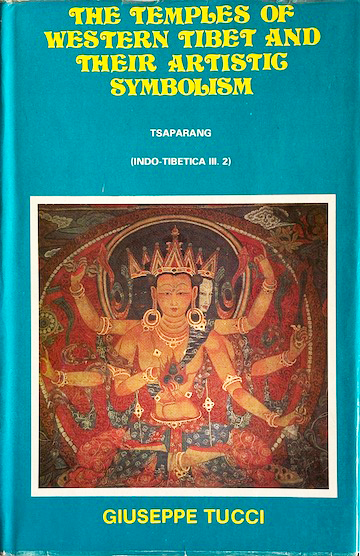
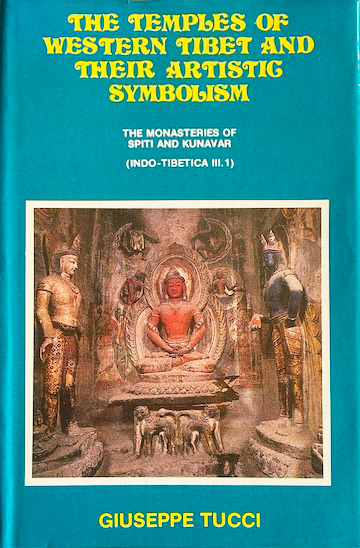
The Temples of Western Tibet and their Artistic Symbolism
Band/Volume 1: The Monasteries of Spiti and Kunavar (Indo-Tibetica III. 1)
Band/Volume 2: Tsaparang (Indo-Tibetica III. 2)
von / by Giuseppe Tucci
Herausgegeben von / Edited by Lokesh Chandra
Band/Volume 1: The Monasteries of Spiti and Kunavar
This volume describes the ancient monasteries of Spiti and Kunavar, namely, those at Tabo, Lhalung, Chang and Nako. Prof. Tucci has identified the paintings of mandalas and individual deities in the temples and elucidated their symbolism at length. The abundance of mystic meanings of the deities and cycles represented is interpreted from Sanskrit and Tibetan texts. The first chapter details the main temple of the monastic complex of Tabo, dedicated to the Vajradhatumandala. The second describes the Gser-khan or Golden Temple of Tabo. Its walls are covered with ancient frescoes that go back to the 16th century. The Dkyil-khan or Mandala Temple constitutes the third chapter. Its paintings are from the 17th century.
Chapter IV is devoted to the minor temples at Tabo. The next three chapters V, VI and VII take up the temples at Lhalung, at Chang, and at Nako. The Nako temple has frescoes of the 14-15 century.
This volume is of unique importance to understand the fundamentals of Vajrayâna art as a concomitant of mysteriosophic realisation. Prof. Tucci has propounded the symbolic and esoteric meaning of the mandalas at length, and in depth which is unique to him. Two Kashmiri wooden sculptures of 10-11th century in the Tabo Gtsug-lag-khan are valuable for the history of Indian art.
A detailed preface by Lokesh Chandra throws further light on the mandalas of Vairocana, which dominate the temples in this volume. He clarifies the various types of these mandalas.
Band/Volume 2: Tsaparang
This volume of the Indo-Tibetica is dedicated to the six temples of Tsaparang, the temples of Samara and of Vajrabhairava, the White Temple, the Red Temple, the Temple of the Prefect, and the Lo-than dgon-pa. These temples are unique examples of early Tibetan mural paintings as well as sculptures, all direct derivations from Indian traditions, and some of them even from the brush of Indian masters. In the feminine deities frescoed on the walls we can discern the continuation of the tradition of Indian miniatures. Professor Tucci speaks at length about the importance of the art of these temples. He discusses the evident traces of Indian inspiration in the accuracy of execution, the delicacy of drawing, chairoscuro effects, figures in profile rather than in frontal aspects, and so on.
The art of Tsaparang has unique importance for the last phase of Buddhist art in India, especially in its Kashmiri idiom. He deals at length with the iconography and symbolism of Samara; his mandala along with its dakinis and asta-smasāna. The mandala of Vajrabhairava, various cycles of Vairocana, Tara, Vajrapâni and Guhyasamaja are also detailed.
In a long preface Prof. Lokesh Chandra elucidates the problems left open by Tucci, like the role of photism in the developments from Amitabha to Mahavirocana, and the transforination from the orgiastic Aksobhya cults to yab-yum mahâyoga deities, dichotomy of square and circle in the mandala, various classifications of the forms of Tara, and so on.
The volume is a must for the History of Art, Buddhism, Indian Art of the post-millenium, Tibetology, Cultural Anthropology and Himalayan Studies.
– Antiquarisches Exemplar, Bücher sehr gut, Schutzumschläge mit Gebrauchsspuren –
Band/Vol. 1: 217 Seiten + 101 s/w-Bildtafeln u. 1 Farbtafel / Band/Vol. 2: 212 Seiten + 152 s/w-Bildtafeln u. 1 Farbtafel, geb. mit Schutzumschlag, Englisch, Aditya Prakashan, New Delhi, 1988/1989, Format 16,5 x 24,4 cm